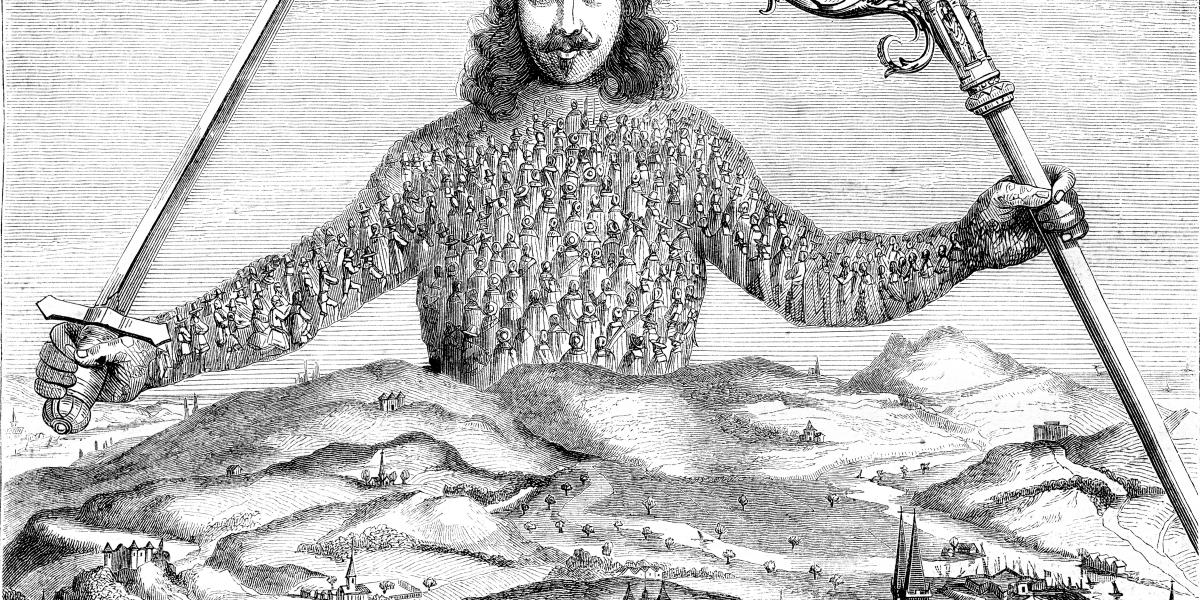
the thesis seems to be that hobbes’ premise of people being naturally at odds with one another contradicts the idea of authority of the government because the government’s power is wielded by some of the very people who are at odds with others.
i haven’t read hobbes in a long time, and i’m not going to read it again, but the way i remember it he presented the formation of states as inevitable. people are stronger or weaker than each other 1v1, but they’re still so close in power that a 2v1 or 3v1 will always favor the greater number.
so men, in their conflict with one another, inevitably form posses. the biggest posse always wins. so the posses become bigger and bigger until it is one big posse confined by geographical barriers, whose job it is mostly to ensure posse members play by the rules that had to be instituted in order for the posse to survive long enough to become large. that becomes a nation-state. someone has to be in charge of the posse, he or they become the sovereign.
it’s possible hobbes applied some kind of “just so” rationalization to suggest that because this is how things go it’s natural or what God intended or ideal or whatever. i don’t remember.
but all the same this essayist misses the point. the social contract is not a solution that was proposed and accepted to solve our human problem. the situation existed before hobbes described it. it’s cause and effect. something that comes about organically, whether you propose it or not.
if we took the takedown of hobbes aspect out of this essay (which, to me, seems like the academic equivalent of posting under a popular hashtag in hopes that someone will notice you), and just focused on the apparent contradiction - sovereignty is a weapon that makes people unequal - it’s like yeah, that’s a kind of sad and tragic aspect of the human condition. is there a “so what?” in the second half of the essay?
i think with the exception of failing empires (you are here), you could argue that the people who end up sovereign are typically better than those they are sovereign over. this numbnuts essayist probably wouldn’t say that, because at heart he’s a liberal. believes in the blank slate. believes we’re all the same it’s just education. believes a peasant could learn to be a king. look at his picture. the physiognomy.
Human imperfection and conflict are the great realities of human existence. I'm not really sure we have any solutions to these problems, at this particular time.
Maybe separation? That's the solution proposed by Hoppe. Some of us who are capable of voluntary non-violence would like to be separated from both the people who can't and the state. Because we aren't the ones causing the problem. And those two groups are largely the same people.
The problem is if peaceful people try to separate from the state the state turns this into a violent situation. Then they call the people they engaged in violence with a violent separatist movement, who needs to be treated with violence because look at all the violence that just happened.
I guess the trick is to separate unobtrusively, and non-violently -- the way of the hermit. And, if someone, or some government entity intrudes on your solitude, to simply avoid them, and make it not worth their trouble to bother you.
No. Violently. Access to peaceful people is not a human right, unless you yourself are peaceful. It's not a right the government possesses either. But the government demands access to all people's bank accounts even if they are peaceful.
People who can't keep their hands to themselves should get out of my space, not the other way around.
Well, morally you are probably right, my friend. And, if the forces opposing you are less powerful than you are, that approach is an option. However, if the forces opposing you are more powerful than you are -- and, in the case of the government, they almost always are more powerful than you are -- then, this approach is not usually an option. You cannot usually, effectively, violently oppose the government. However, you can, quite often, avoid the government, and, rather subtly, but quite effectively, make it too much trouble for the government to bother you. Trust me, I have some experience in these matters.
 Log in



the thesis seems to be that hobbes’ premise of people being naturally at odds with one another contradicts the idea of authority of the government because the government’s power is wielded by some of the very people who are at odds with others.
i haven’t read hobbes in a long time, and i’m not going to read it again, but the way i remember it he presented the formation of states as inevitable. people are stronger or weaker than each other 1v1, but they’re still so close in power that a 2v1 or 3v1 will always favor the greater number.
so men, in their conflict with one another, inevitably form posses. the biggest posse always wins. so the posses become bigger and bigger until it is one big posse confined by geographical barriers, whose job it is mostly to ensure posse members play by the rules that had to be instituted in order for the posse to survive long enough to become large. that becomes a nation-state. someone has to be in charge of the posse, he or they become the sovereign.
it’s possible hobbes applied some kind of “just so” rationalization to suggest that because this is how things go it’s natural or what God intended or ideal or whatever. i don’t remember.
but all the same this essayist misses the point. the social contract is not a solution that was proposed and accepted to solve our human problem. the situation existed before hobbes described it. it’s cause and effect. something that comes about organically, whether you propose it or not.
if we took the takedown of hobbes aspect out of this essay (which, to me, seems like the academic equivalent of posting under a popular hashtag in hopes that someone will notice you), and just focused on the apparent contradiction - sovereignty is a weapon that makes people unequal - it’s like yeah, that’s a kind of sad and tragic aspect of the human condition. is there a “so what?” in the second half of the essay?
i think with the exception of failing empires (you are here), you could argue that the people who end up sovereign are typically better than those they are sovereign over. this numbnuts essayist probably wouldn’t say that, because at heart he’s a liberal. believes in the blank slate. believes we’re all the same it’s just education. believes a peasant could learn to be a king. look at his picture. the physiognomy.
there, would starjello say THAT? i don’t think so
Look at Luigi though.
good physiognomy
Human imperfection and conflict are the great realities of human existence. I'm not really sure we have any solutions to these problems, at this particular time.
Maybe separation? That's the solution proposed by Hoppe. Some of us who are capable of voluntary non-violence would like to be separated from both the people who can't and the state. Because we aren't the ones causing the problem. And those two groups are largely the same people.
The problem is if peaceful people try to separate from the state the state turns this into a violent situation. Then they call the people they engaged in violence with a violent separatist movement, who needs to be treated with violence because look at all the violence that just happened.
I guess the trick is to separate unobtrusively, and non-violently -- the way of the hermit. And, if someone, or some government entity intrudes on your solitude, to simply avoid them, and make it not worth their trouble to bother you.
No. Violently. Access to peaceful people is not a human right, unless you yourself are peaceful. It's not a right the government possesses either. But the government demands access to all people's bank accounts even if they are peaceful.
People who can't keep their hands to themselves should get out of my space, not the other way around.
Well, morally you are probably right, my friend. And, if the forces opposing you are less powerful than you are, that approach is an option. However, if the forces opposing you are more powerful than you are -- and, in the case of the government, they almost always are more powerful than you are -- then, this approach is not usually an option. You cannot usually, effectively, violently oppose the government. However, you can, quite often, avoid the government, and, rather subtly, but quite effectively, make it too much trouble for the government to bother you. Trust me, I have some experience in these matters.
I had something really witty to add to this post but lost it