 Log in

| 1 | ||
| 1 | ||
| 1 | ||
| 1 | ||
| 1 |
[Facebook copypasta from Tyler Hanson. I didn't ask him if he wrote it or not.]
There it is again—the great digital circus, a million glowing rectangles humming in the dark, and somewhere in the middle of it all, a guy in gym shorts is dissolving laundry detergent in a mason jar and calling it “wellness.” This is where we are now. The species that split the atom has decided to snack on cleaning products because a 22-second video said it might help their joints.
Borax. A substance that, until a few years ago, lived an honest, respectable life under sinks and next to buckets labeled industrial use only. And now—thanks to the algorithmic fever dream machine—it’s being rebranded as a miracle tonic for the chronically online and terminally gullible. Not because there’s evidence. Not because doctors woke up one morning and said, “By God, we’ve been wrong—hand me the detergent.” No. It’s because it sounds just plausible enough to slip past the last remaining guardrail in people’s brains.
The magic trick here is almost beautiful in its stupidity. Someone whispers “boron”—a trace mineral with actual, limited research—and then quietly swaps it out for “borax,” which is what you use to scrub mildew off your bathtub. Same word-adjacent, same vibe, totally different reality. It’s like confusing table salt with road salt and deciding the highway department has been hiding a gourmet secret from you.
And the crowd eats it up. Of course they do. It’s cheap, it’s “natural,” it feels like forbidden knowledge—the holy trinity of bad decisions. People desperate for relief from pain or fatigue see a grainy video and suddenly they’re amateur chemists, measuring out poison like they’ve cracked the Da Vinci Code of inflammation. The comments fill up with testimonies that read like hallucinations: “Day 3 and I feel AMAZING.” Yeah, fantastic. So does a man running barefoot through traffic until the bus arrives.
Social media doesn’t reward truth—it rewards spectacle. And nothing says spectacle like a dangerous “hack” dressed up as ancient wisdom. A doctor calmly explaining toxicity? Boring. A guy in his car whispering, “They don’t want you to know this”? That’s rocket fuel for the brain’s worst impulses.
What’s really staggering isn’t just that people try this—it’s how eagerly they spread it. The moment someone believes they’ve uncovered hidden knowledge, they turn into evangelists. Suddenly it’s not enough to quietly sip your cleaning solution; you have to recruit others, drag them into the madness, build a whole little cult of misguided chemistry experiments. It’s less about health and more about the intoxicating feeling of being “in on something.”
But strip away the noise, and the truth sits there, dull and unglamorous: borax is not food. It’s not medicine. It’s not a secret cure buried by shadowy elites. It’s a cleaning agent that wandered out of the utility closet and into the bloodstream of a culture that confuses virality with validity.
And maybe that’s the real disease—not inflammation, not joint pain, but this ferocious hunger for easy answers wrapped in the aesthetic of rebellion. People don’t just want to feel better; they want to feel smarter than everyone else while doing it. Even if it means chugging something that, in any sane era, would have been recognized immediately as a terrible idea. Cause you are literally drinking poison
The internet didn’t invent stupidity—but it sure as hell gave it a megaphone, a ring light, and a comment section full of applause.
I truly wonder what Darwin would have to say about the evolution of humanity today.
Yours Truly
Registered Big Pharma Bot
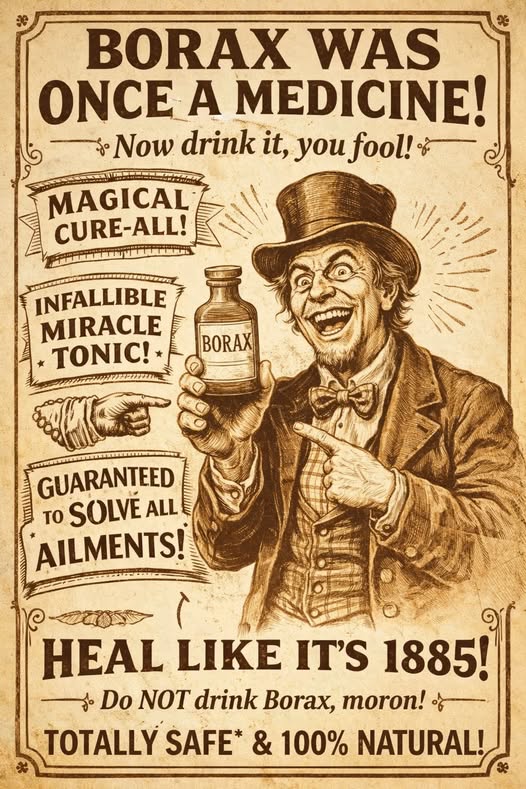

Like TikTokers eating Tide Pods.